What is the Pilates Reformer?
Anatomy of the machine: carriage, springs, footbar, straps
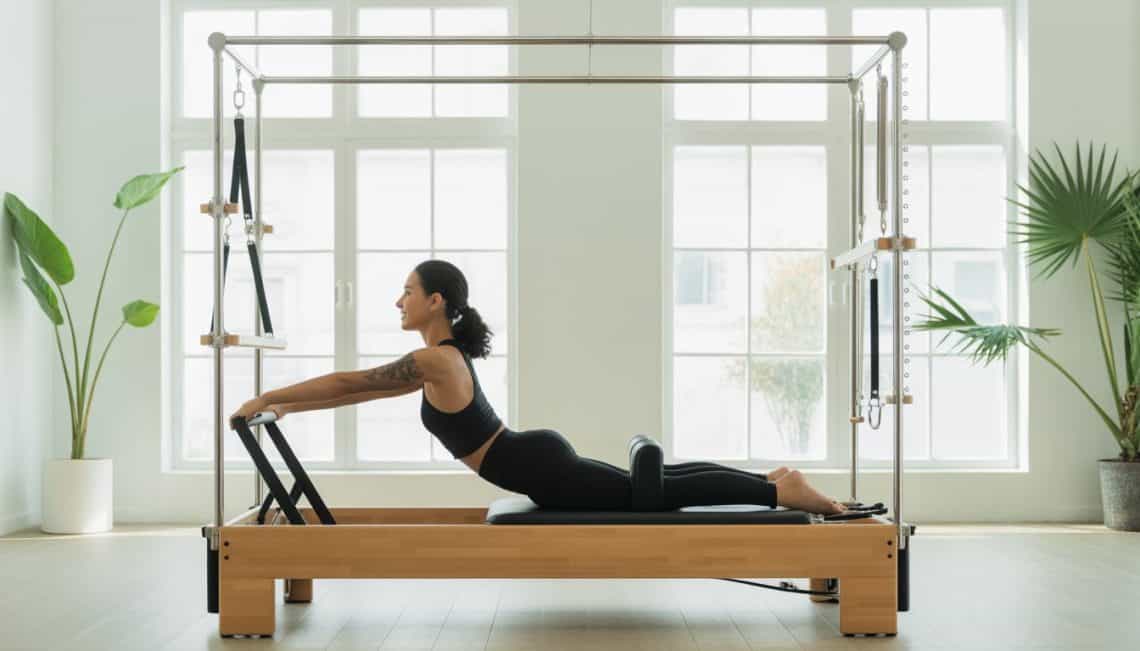
The Pilates reformer is a low, horizontal frame with a moving platform called the carriage that slides along rails. Tension comes from a set of detachable springs under the carriage; other key parts are the footbar at one end, adjustable straps or handles, shoulder blocks to hold the carriage in place, and often a headrest and shoulder pads for comfort.
People sometimes think it’s complicated, but at its heart the reformer is a simple resistance and stability tool: the carriage, springs, footbar and straps work together to create assisted, resisted or unstable movement suitable for many levels.
How reformer Pilates differs from mat Pilates
Reformer Pilates uses equipment to add resistance, support or instability, so exercises that are tough on the mat can become more accessible — or more challenging — on the reformer. Mat work relies mostly on bodyweight and gravity; the reformer offers precise spring-based load and smooth sliding motion that change the feel of core, limb and mobility work.
In short, mat Pilates is portable and minimalist, while the reformer expands options for progression, regression and rehabilitation — making both complementary rather than competing practices.
Core Pilates principles applied on the reformer
The classic Pilates principles — centring (core engagement), breathing, control, precision, flow and concentration — apply directly on the reformer. The machine’s resistance emphasises control and precision, while the sliding carriage challenges stability and breath timing in dynamic movements.
Using the reformer, instructors can highlight posture, alignment and functional movement patterns, helping learners translate Pilates principles into everyday strength and mobility.
Top benefits of reformer Pilates
Full‑body strength, posture and mobility
Far from being just “core work,” reformer Pilates trains the whole body. The combination of springs and bodyweight builds balanced strength in the posterior chain, anterior core and shoulder stabilisers, while also improving posture and joint range of motion.
Because resistance is adjustable, practitioners can progress safely from mobility-focused sessions to strength-oriented work without jumping straight into heavy weights.
Rehab, pain relief and injury prevention
The reformer is widely used in rehab settings because it allows controlled loading, assisted movement and precise range-of-motion adjustments. For many with low-back or shoulder issues, reformer work improves function and pain when programmed correctly (see clinical guidance from exercise and rehab bodies).
That said, exercises must be prescribed carefully; a qualified instructor and, when needed, a healthcare professional should guide rehabilitation progressions to avoid aggravation.
Balance, coordination and mental focus
The sliding carriage and straps demand co-ordination and proprioception, so reformer classes naturally boost balance and neuromuscular control. Many learners also note improved concentration and body awareness after consistent practice.
Because each movement requires mindful control, the reformer can be both physical and mentally engaging — a good counter to distracted, multitasking training routines.
Who should — and shouldn’t — try reformer Pilates
Ideal candidates: beginners, seniors, athletes, rehab patients
Contrary to the myth that reformer is only for fit people, beginners and seniors often benefit because the springs provide support and adjustable resistance. Athletes use it for mobility, injury prevention and cross-training, while rehab patients find it useful for gradual, controlled loading.
Beginners should start with an instructor-led class to learn mechanics; with proper coaching, the reformer suits a wide range of ages and fitness levels.
Special populations: pregnancy and postnatal considerations
Pregnant and postnatal clients can use the reformer but need modifications. Some exercises and spring tensions are adjusted to avoid excessive intra‑abdominal pressure and to protect pelvic floor health. Guidance from qualified instructors and obstetric healthcare professionals is recommended (see ACOG and local health guidance).
Many studios offer prenatal and postnatal reformer classes tailored to each trimester or recovery phase; these are safer than generic classes for expectant or new mothers.
Contraindications and when to consult a healthcare professional
Serious osteoporosis, uncontrolled high blood pressure, unstable cardiac conditions, certain hernias, or recent surgeries may be contraindications for reformer work until cleared by a healthcare professional. Acute injuries and severe balance disorders also warrant caution.
When in doubt, the sensible approach is to consult a physician or physiotherapist before starting reformer Pilates, especially for known medical conditions or pregnancy.
How the reformer works: springs, resistance and setup
Understanding springs, tension and carriage dynamics
Springs provide variable resistance: more springs = more force to move the carriage; fewer springs = lighter load and more assistance. The carriage’s mass and the direction of force change how muscles must work to accelerate, decelerate and stabilise motion.
Learning how spring tension interacts with body position is the key to safely scaling exercises up or down for strength, mobility or neuromuscular control.
Adjusting footbar, headrest, straps and spring combinations
Small setup changes make big differences. Moving the footbar closer shortens the lever for lower-body work; changing headrest height can make neck positions safer; strap length alters range of motion. Combining springs allows fine-tuning of assistance or resistance for individual needs.
Instructors teach setup because it directly affects joint loading and exercise intention — learners should not rely on guesswork when adjusting equipment.
How setup changes the exercise: assist vs resist vs instability
Depending on configuration, the reformer can assist movement (fewer springs or strap support), resist it (more springs or added range) or introduce instability (single-leg work, long strap work). These modes let the same basic pattern be used for rehabilitation, strength-building or balance training.
Knowing the goal — assist, resist or destabilise — helps instructors pick the right setup for progressions and regressions.
Essential reformer exercises and beginner progressions
Core starter moves: footwork, hundreds and short spine
Classic beginner moves include footwork (pressing the carriage with the feet), the reformer version of the hundreds (with straps or hands for support) and short spine massage (controlled spinal articulation while the carriage moves). These teach breathing, alignment and carriage control.
Beginners focus on slow tempo, neutral spine and coordinated breath before adding spring tension or more range of motion.
Lower‑body and glute progressions: leg circles, Frog, Scooter
Lower-body progressions often start with supported leg circles and single-leg footwork, then move to Frog and Scooter variations that activate glutes and hips. Each step increases demand on stability and strength while keeping movement quality front and centre.
Progressions are simple: increase range, reduce assistance, add single-leg work, or change spring combinations to challenge strength and control.
A 20‑minute beginner sequence you can try
A basic 20-minute beginner session might flow: 1) 5 minutes footwork and gentle carriage warm-up; 2) 5 minutes core work (modified hundreds, pelvic tilts); 3) 6 minutes lower-body moves (leg circles, Frog); 4) 4 minutes cool-down with gentle bridging and stretches. Keep springs light and focus on alignment.
This short, structured practice gives a snapshot of how reformer sessions combine strength, mobility and breath — ideal for starters building confidence.
Types of reformer classes and how to choose one
Private session vs small group vs large class vs hybrid/online
Private sessions offer one-to-one coaching and personalised setup — best for rehab, specific goals or absolute beginners. Small groups (3-6 people) balance personalised attention and a shared vibe. Large classes are more affordable but provide less individual correction. Hybrid and online options suit maintenance, travel or supplementing in-person lessons.
Choice depends on budget, learning style and whether close hands-on cueing is needed for safety or progress.
What to expect in your first class and common class formats
First classes usually include equipment orientation, a gentle warm-up, basic exercises with clear cues, and time for questions. Common formats include full-reformer flows, targeted sessions (legs, shoulders, stretch), and mixed equipment classes with tower or chair attachments.
Beginners should expect a focus on alignment and breathing rather than flashy moves; instructors often reduce spring tension to help learning.
How to evaluate instructors and studio safety standards
Good instructors explain modifications, observe form closely, and adjust spring/setup for each client. Studios should maintain clean, well-serviced equipment, limit class sizes appropriately, and have clear policies for injuries or medical disclosures. Credentials from reputable bodies (e.g., Pilates Method Alliance or equivalent) are a useful indicator of training.
Prospective clients can ask about instructor qualifications, class ratios and emergency procedures before booking.
Buying, renting and choosing the right reformer
Home vs studio reformers: frame, carriage and footprint differences
Home reformers are often more compact, lighter and sometimes foldable, while studio models usually have commercial-grade frames, larger carriages and heavier-duty springs. Studio reformers may feel sturdier and allow a wider range of attachments but take up more floor space.
Buyers should match the machine’s size and durability to intended use: casual home practice vs daily commercial classes demand different specifications.
Key features to compare: materials, spring system, adjustability, warranty
Important features include frame material (wood vs metal), spring anchoring and range, adjustable footbar positions, strap attachments, headrest options, and warranty terms. A simpler machine with reliable springs and good adjustability often beats gimmicky extras for long-term satisfaction.
Check warranty and parts availability, especially for springs and straps that wear with heavy use.
Price brackets, rental/try‑before‑you‑buy options and used machine tips
Reformers range from budget home models to premium commercial units. Renting, studio trial passes or short-term rentals are smart for newcomers who aren’t ready to buy. When buying used, inspect springs, straps, carriage glide and frame integrity; replacing springs and straps is normal but visible rust or cracked frames are red flags.
Comparing total cost of ownership (shipping, maintenance, accessories) helps avoid surprises when investing in a reformer.
Accessories, maintenance and space planning
Useful add‑ons: jumpboard, box, straps, tower upgrades
Common accessories extend exercise variety: a jumpboard adds low-impact plyometrics, a box or padded platform enables seated or stand-up variations, and towers or Cadillac-style attachments broaden upright and hanging work. Extra straps or handles can adapt grips for mobility-limited clients.
Studios and home users should choose accessories that match training goals rather than buying everything at once.
Routine care: cleaning, spring inspection and basic repairs
Routine care includes wiping surfaces after use, checking springs and hooks for fatigue or corrosion, inspecting straps and handles for fraying, and keeping rails lubricated per manufacturer guidance. Replace worn springs and straps promptly to maintain safe resistance and range.
Many issues are preventable with simple checks; studios should keep a maintenance log and homeowners should follow manufacturer care instructions.
How much space you need and smart storage/placement tips
A single reformer typically needs about the machine’s footprint plus room at each end for movement — roughly 2.5m x 1m as a baseline, though compact models require less. Account for ceiling height if planning vertical attachments or tower work.
Position the reformer on a flat surface, allow access to both sides, and use protective floor mats if needed; for small homes, foldable or shortened home models and vertical storage options can save space.
Safety, common injuries and instructor qualifications
Typical mistakes and how to avoid them
Common mistakes include using too much spring tension too soon, rushing range of motion, holding breath, and neglecting scapular stability. These errors increase strain on joints and reduce exercise effectiveness.
To avoid problems, progress gradually, prioritise form over reps, and follow an instructor’s cues for breathing and scapular positioning.
Modifications for back pain, knee issues and other common conditions
For low-back pain, instructors often reduce spring tension, limit lumbar extension, and focus on neutral-spine control and pelvic stability. Knee issues are managed by adjusting footbar position, reducing range, or using straps for support to lower joint load.
Always tailor modifications to the condition and seek input from a physiotherapist when dealing with persistent pain or complex diagnoses.
Certifications and questions to ask before booking a session
Look for instructors with recognised Pilates training from organisations such as the Pilates Method Alliance or internationally respected teacher training programs. Ask about their experience with rehabilitation, class sizes, and whether they carry public liability insurance.
Questions to ask: “How long have you taught reformer?”, “Do you modify for medical conditions?”, and “What are your class ratios?” These help gauge safety and fit.
Programming your reformer training for results
How often to train and beginner 10 intermediate progression
Beginners often benefit from 1-3 sessions per week to build skill and consistency; as proficiency grows, 3-4 weekly sessions can accelerate strength and mobility gains. Progressions move from learning alignment and light springs to longer ranges, single-leg variations and heavier spring loads.
Patience is key: short, frequent practices with good coaching beat occasional long sessions for steady improvement.
Combining reformer with strength, cardio and flexibility work
The reformer complements strength training and cardio rather than replacing them. Many practitioners use reformer work for mobility, core and coordination days, and reserve free weights or machines for heavy-load strength. Cardio can be scheduled separately; hybrid sessions (short metabolic intervals on the reformer) are also possible with an instructor’s input.
Balancing modalities helps avoid overuse and ensures broad fitness development.
Tracking progress: metrics, exercises to retest and realistic timelines
Useful metrics include improved range of motion, ability to use fewer springs for a given exercise, increased reps with maintained form, and decreased pain or improved daily function. Retest core moves, single-leg footwork and short spine progressions every 4-8 weeks to monitor progress.
Realistic timelines: noticeable improvements in control and awareness can appear in weeks, while meaningful strength and postural changes often take 8-12 weeks of consistent practice.
FAQ, resources and next steps
Quick answers to frequently asked questions (space, cost, classes)
Space: compact home reformers reduce footprint but still need room to mount/dismount. Cost: beginner home models start lower while commercial units cost more; many people try studio classes before buying. Classes: beginners should choose introductory or private lessons to learn setup and basics.
These practical points help people decide whether to start with studio classes, online subscriptions or investing in their own equipment.
Best online classes, apps, and further reading for all levels
There are reputable online platforms and apps offering reformer content ranging from beginner tutorials to advanced flows; look for teachers with recognised training and clear camera angles showing setup. Many studios also offer hybrid programmes combining in-studio assessment with online follow-ups.
For deeper reading, consult resources from recognised bodies such as the Pilates Method Alliance and mainstream health organisations for pregnancy and rehabilitation guidance (e.g., ACOG, NHS) to ensure safe practice.
Glossary of common reformer terms and where to find certified instructors
Common terms: carriage (moving platform), springs (resistance), footbar, straps/handles, box, tower, short spine, footwork. To find certified instructors, check local studio listings, Pilates networks, or national directories; ask about specific reformer training and experience with special populations.
When searching, prioritise studios with transparent safety policies and instructors who welcome medical disclosures before class.